

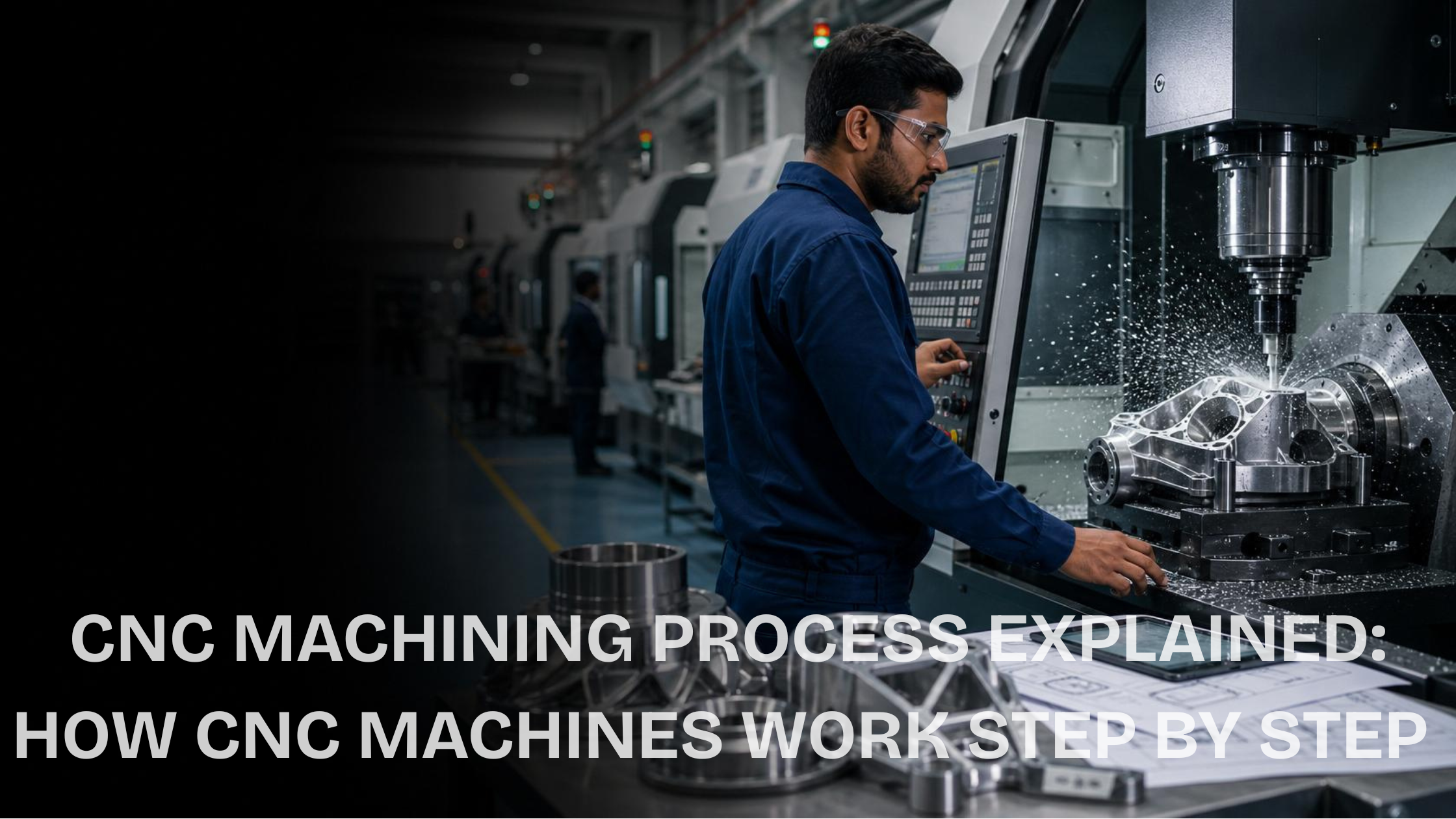
The CNC machining process powers modern manufacturing, enabling the production of highly precise and complex parts at scale. From aerospace components to everyday consumer products, CNC machines play a critical role in ensuring accuracy, consistency, and efficiency.
If you’ve ever wondered about the CNC machine working process, it involves a seamless blend of software, automation, and mechanical precision. In this guide, we break down how CNC machining works, the different types of CNC machines, and provide a step-by-step look at the entire process.
Click the section to read
- What Is CNC Machining?
- How Does CNC Machining Work?
- CNC Machine Programming Explained
- Types of CNC Machines
- CNC Machining Process: Step-by-Step Guide
- CNC Machine Assembly Process
- CNC Milling Machine Process Explained
- What Else Can a CNC Machine Do?
- FAQ: What type of machining process is CNC milling?
- FAQ: What is the CNC machine working process?
- FAQ: How accurate is CNC machining?
What Is CNC Machining?
CNC (Computer Numerical Control) machining is a manufacturing process in which preprogrammed software controls the movement of machinery and tools. Unlike manual machining, CNC systems automate cutting, drilling, and shaping operations with minimal human intervention.
This subtractive manufacturing method removes material from a solid block to create the desired shape. It is widely used across industries such as automotive, aerospace, electronics, and medical manufacturing for its ability to produce consistent, high-quality components.
How Does CNC Machining Work?
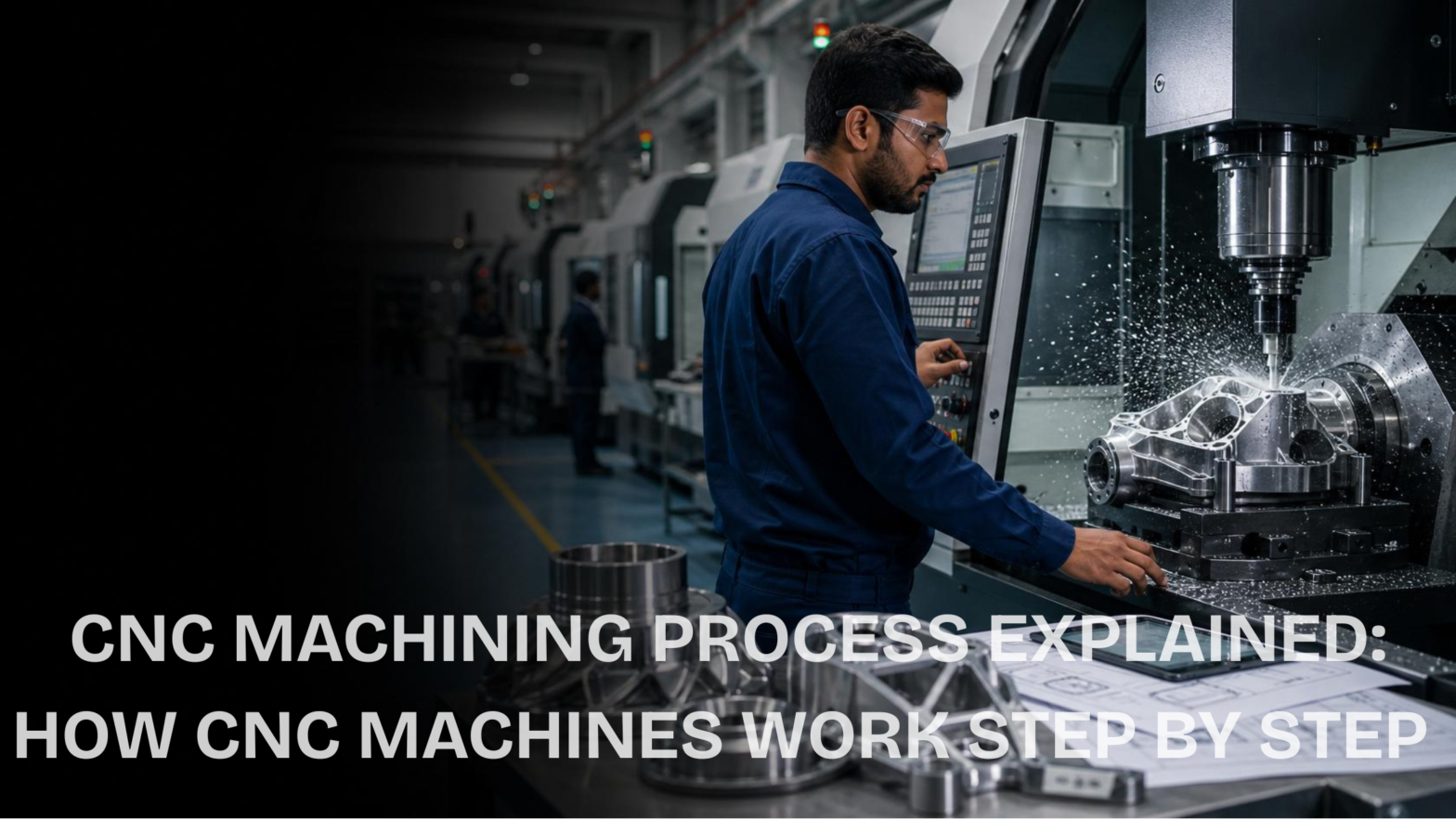
Disclaimer: This is an AI-generated image. AI images may have inaccuracies.
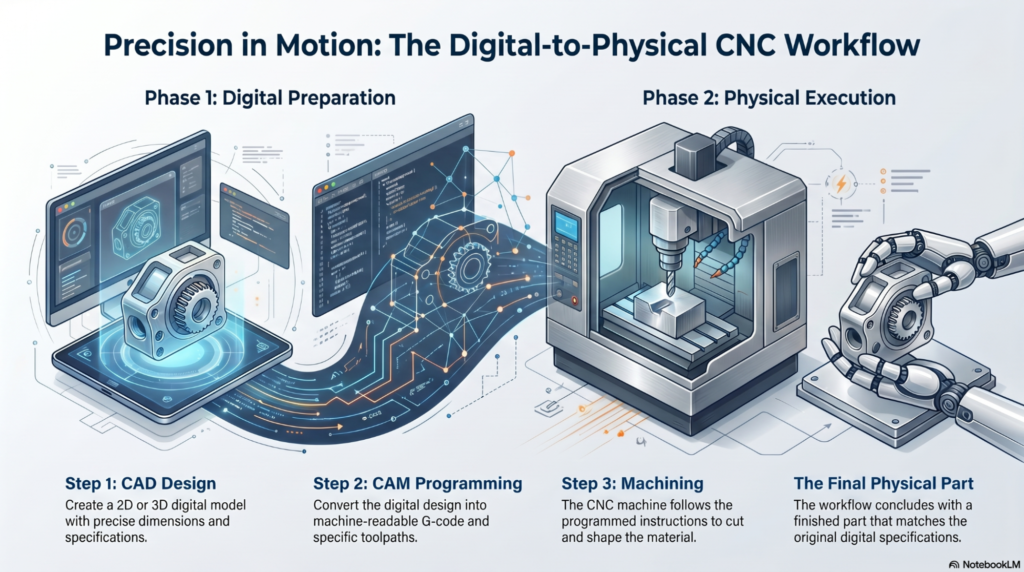
At its core, the CNC machining process follows a digital-to-physical workflow. A design is created using software, translated into machine instructions, and then executed by the CNC machine to produce the final part.
This process is often represented through a CNC machining process flow chart that includes three main stages:
- Design (CAD)
- Programming (CAM)
- Machining (Execution)
Each stage plays a crucial role in ensuring the final product meets exact specifications.
CNC Machine Programming Explained
CNC machines rely on programmed instructions to perform tasks with precision. These instructions are typically written in G-code and M-code, which control aspects like tool movement, speed, and positioning.
G-code dictates the geometry of the cut, guiding the machine along specific paths, while M-code manages auxiliary functions such as coolant flow or tool changes.
Modern CAM software simplifies this process by automatically generating code based on the CAD design. This ensures accuracy, reduces manual errors, and allows for repeatable production across multiple batches.
Types of CNC Machines
CNC Milling Machines
CNC milling machines are among the most commonly used systems in manufacturing. The CNC milling machine process involves rotating cutting tools that remove material from a stationary workpiece.
If you’re asking, what type of machining process is CNC milling? The answer is that it is a subtractive machining process. It is ideal for creating complex shapes, slots, holes, and intricate surface details.
CNC Lathes
CNC lathes rotate the workpiece while a stationary cutting tool shapes it. These machines are commonly used for cylindrical parts such as shafts, rods, and bushings.
CNC Routers
CNC routers are typically used for softer materials like wood, plastic, and composites. They are widely used in furniture making, signage, and decorative applications.
CNC Plasma Cutters
CNC plasma cutters use a high-velocity jet of ionized gas to cut through electrically conductive materials such as steel and aluminum. They are commonly used in metal fabrication.
CNC EDM Machines
Electrical Discharge Machining (EDM) uses electrical sparks to erode material. It is especially useful for hard metals and intricate designs that are difficult to achieve with traditional cutting tools.
Read more: 13 Types of CNC Machines and Their Application
CNC Machining Process: Step-by-Step Guide
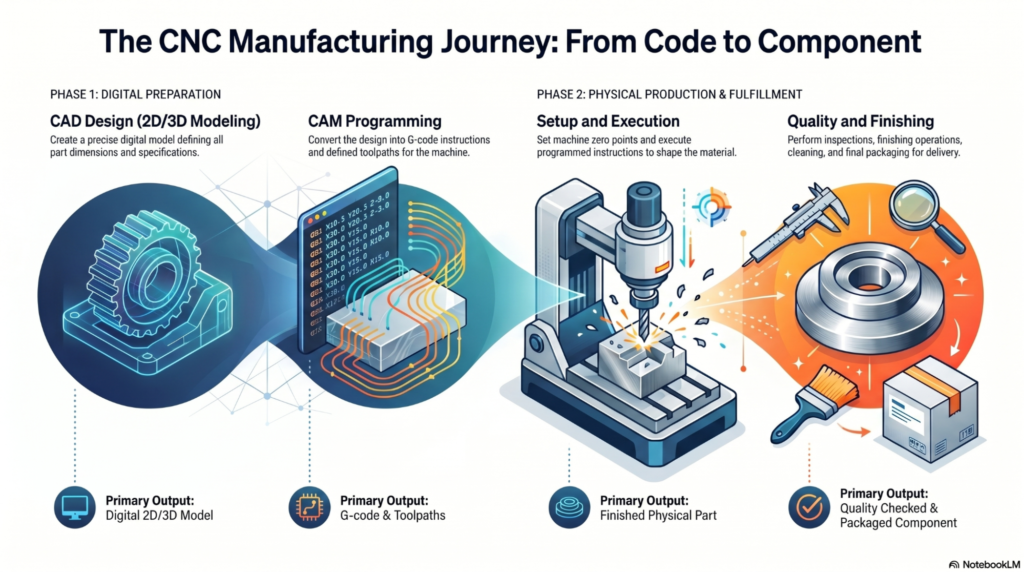
Step 1: Designing the Part (CAD Development)
The process begins with creating a digital model using CAD (Computer-Aided Design) software. Engineers design the part in 2D or 3D, defining dimensions, tolerances, and geometry.
Step 2: CAM Programming & Toolpath Creation
The CAD design is then imported into CAM (Computer-Aided Manufacturing) software. Here, toolpaths are generated to determine how the cutting tools will move to shape the part.
Step 3: Machine Setup & Tool Preparation
Before machining begins, the CNC machine is prepared with the required tools, fixtures, and settings. Operators ensure that everything is calibrated for precision.
Step 4: Workpiece Loading & Zero Point Setting
The raw material, known as the workpiece, is securely mounted onto the machine. A zero point or reference position is set to guide accurate machining operations.
Step 5: Machining Execution
This is where the CNC machining process comes to life. The machine follows programmed instructions to cut, drill, mill, or shape the material into the desired form.
Step 6: Quality Inspection & Measurement
After machining, the part is inspected using precision measuring tools to ensure it meets required tolerances and specifications.
Step 7: Finishing Operations
Additional processes, such as polishing, deburring, coating, or surface treatment, are performed to enhance the part’s appearance and functionality.
Step 8: Cleaning & Packaging
Finally, the part is cleaned to remove any residues and carefully packaged for delivery or further assembly.
Disclaimer: This is an AI-generated image. AI images may have inaccuracies.
CNC Machine Assembly Process
The CNC machine assembly process involves the careful integration of mechanical, electrical, and software components to create a fully functional and precise manufacturing system. Each part of the machine must be aligned and calibrated accurately to ensure smooth operation and consistent performance.
Overview of how CNC machines are built:
- Assembly begins with the machine frame, which provides structural stability and absorbs vibrations during operation
- Linear guides, ball screws, and motion systems are installed to enable precise multi-axis movement
- Electrical systems, wiring, and control panels are integrated to connect hardware with software
Key components:
- Controller: The brain of the CNC machine that interprets G-code and directs movements
- Spindle: The rotating component that holds and drives the cutting tool at varying speeds
- Motors (Servo/Stepper): Responsible for precise motion control across different axes
- Machine Frame: A rigid base that ensures stability, accuracy, and minimal deflection during machining
Importance of precision assembly:
- Ensures high accuracy and repeatability in machining operations
- Reduces vibration and mechanical errors
- Improves machine longevity and performance
- Minimizes maintenance issues and downtime
CNC Milling Machine Process Explained
The CNC milling machine process is a highly versatile and widely used subtractive manufacturing method. It involves removing material from a workpiece using rotating cutting tools to achieve precise shapes and features.
Key aspects of the CNC milling process:
- The cutting tool rotates at high speed while the workpiece remains stationary or moves along defined axes
- Multi-axis movement (3-axis, 4-axis, or 5-axis) allows for complex geometries and detailed designs
- Toolpaths are pre-programmed using CAM software to ensure accuracy and efficiency
- Material is removed layer by layer, enabling tight tolerances and smooth finishes
Tool rotation vs stationary workpiece:
- The cutting tool performs the primary motion through rotation
- The workpiece is fixed on the machine bed, but can move linearly depending on the machine setup
- This combination allows for precise cutting, drilling, slotting, and contouring operations
Materials commonly used in CNC milling:
- Metals: Aluminum, steel, stainless steel, brass, and titanium for industrial and high-strength applications
- Plastics: ABS, nylon, polycarbonate, and acrylic for lightweight and cost-effective components
- Composites: Carbon fiber and fiberglass for high-performance applications
- Wood and foam: Used in prototyping, modeling, and decorative applications
Why is CNC milling widely used?
- Suitable for both prototyping and mass production
- Capable of producing intricate and high-precision parts
- Compatible with a wide range of materials and industries
This makes CNC milling a core part of modern manufacturing, especially when precision and flexibility are critical.
What Else Can a CNC Machine Do?
Beyond standard machining, CNC machines can be used for a wide range of applications. They are widely used for rapid prototyping, allowing manufacturers to quickly test and refine designs before full-scale production.
CNC machines also support mass production by delivering consistent results across large volumes. Additionally, they can create highly customized parts tailored to specific requirements, including complex geometries that would be difficult to achieve manually.
With advancements in multi-axis machining, CNC systems can now handle intricate designs with fewer setups, improving efficiency and reducing production time.
Conclusion
The CNC machining process combines digital design, intelligent programming, and precise execution to produce high-quality parts with remarkable accuracy. Understanding the CNC machine’s working process helps businesses and engineers make better decisions about manufacturing methods.
From initial design to final packaging, each step plays a vital role in delivering reliable and consistent results, making CNC machining an essential part of modern industry.
Looking for reliable and high-precision CNC machining services?
Get in touch with our team today to bring your designs to life with accuracy and efficiency.
FAQ: What type of machining process is CNC milling?
CNC milling is a subtractive machining process where material is removed from a solid workpiece using rotating cutting tools. It is used to create precise shapes, slots, and complex geometries.
FAQ: What is the CNC machine working process?
The CNC machine working process involves designing a part using CAD software, converting it into machine instructions through CAM, and executing the program on a CNC machine to shape the material. It follows a structured flow from design to finished product.
FAQ: How accurate is CNC machining?
CNC machining is highly accurate, typically achieving tolerances of ±0.0001 inches (±0.0025 mm) or better depending on the machine and material. This precision makes it ideal for industries requiring tight tolerances and consistency.
More Blog
How to Choose a CNC Machining Company in India
India has emerged as a global hub for precision...
CNC Machining Process Explained: How CNC Machines Work Step by Step
The CNC machining process powers modern...
13 Main Types of CNC Machines and Their Applications
Computer Numerical Control (CNC) machines have transformed modern manufacturing...