

In today’s competitive global market, businesses are under constant pressure to deliver high-quality products faster, at lower risk, and with greater flexibility. Standardised manufacturing models no longer suit every requirement, especially when products need precision, customisation, or scalability without compromising quality. This is where custom manufacturing services play a critical role.
Custom manufacturing allows businesses to design, produce, and scale products tailored to their exact specifications. From specialised components to full assemblies, companies increasingly rely on custom manufacturing in India to balance cost efficiency with engineering excellence and reliable supply chains.
In this article, we’ll explore what custom manufacturing services are, how they work, their benefits, applications, challenges, and how to choose the right manufacturing partner.
Types of Custom Manufacturing Services
Processes Involved in Custom Manufacturing
Custom Manufacturing vs. Mass Production
Benefits of Custom Manufacturing Services
Materials Used in Custom Manufacturing
Industries That Need Custom Manufacturing Service
How to Choose the Right Custom Manufacturer for Your Project
Why India Is a Preferred Destination for Custom Manufacturing
Frequently Asked Questions (FAQs)
What Is Custom Manufacturing?
Custom manufacturing is a production approach in which products, components, or assemblies are made to specific customer requirements rather than standardised designs. Unlike mass production, which focuses on volume and uniformity, custom manufacturing prioritises flexibility, precision, and adaptability.
These custom manufacturing services can range from one-off prototypes to low- and medium-volume production runs, as well as scalable long-term manufacturing. Custom manufacturing services are widely used across industries such as automotive, industrial equipment, aerospace, electronics, medical devices, and consumer goods.
India has emerged as a global hub for custom manufacturing due to its skilled workforce, advanced engineering capabilities, and cost advantages. Today, custom manufacturing solutions in India are trusted by companies worldwide seeking reliable, high-quality, and agile production support.
Types of Custom Manufacturing Services
Custom manufacturing is not a one-size-fits-all model. It includes several specialised approaches depending on product complexity and volume requirements.
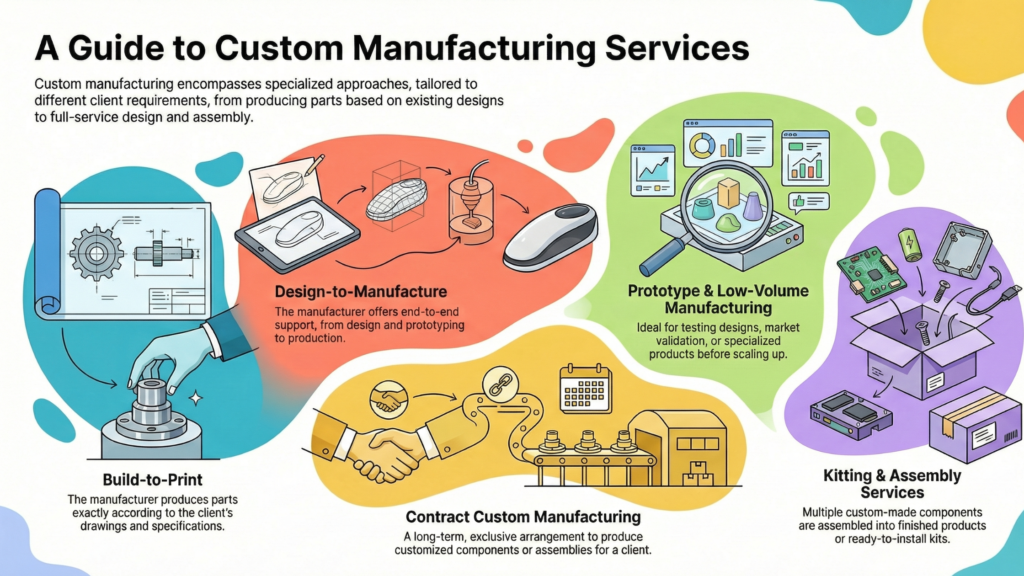
1. Build-to-Print Manufacturing
Manufacturers produce parts exactly as per the client’s drawings and specifications. This is common for CNC machining, castings, forgings, and sheet metal components.
2. Design-to-Manufacture
The manufacturer supports product design, material selection, prototyping, and production, offering end-to-end engineering and manufacturing expertise.
3. Contract Custom Manufacturing
A long-term arrangement where a manufacturer produces customised components or assemblies exclusively for a client.
4. Prototype and Low-Volume Manufacturing
These are Ideal for testing designs, market validation, or specialised industrial products before scaling.
5. Kitting and Assembly Services
Under kitting and assembly service, multiple custom-made components are assembled into finished products or ready-to-install kits.
While processes vary by product and industry, most custom manufacturing services follow a structured workflow.
Disclaimer: This is an AI-generated image. AI images may have inaccuracies.
- Requirement Analysis and Engineering
The process begins with understanding technical drawings, performance expectations, tolerances, compliance standards, and delivery timelines. - Design Validation and Prototyping
Designs are reviewed for manufacturability. Prototypes can be developed using CNC machining, plastic molding, or rapid tooling to validate both form and function. - Material Selection
Materials are chosen based on strength, durability, corrosion resistance, weight, and cost. This step is critical to ensure performance and longevity. - Manufacturing and Fabrication
Depending on the requirement, custom manufacturing processes may include: - Quality Control and Testing
Each stage is monitored through inspections, dimensional checks, and performance testing to ensure compliance with specifications. - Assembly, Packaging, and Delivery
Components may be assembled, kitted, packaged, and shipped globally, providing a turnkey manufacturing solution.
Custom Manufacturing vs. Mass Production- Which one to choose for your business?
Understanding the difference between these two approaches enables businesses to select the most suitable model for their needs.
| Aspect | Custom Manufacturing | Mass Production |
| Product Design | Tailored to specific needs | Standardised |
| Production Volume | Low to medium, scalable | High volume |
| Flexibility | High | Low |
| Lead Time | Faster for complex products | Faster for standard items |
| Cost Structure | Higher per unit, lower tooling risk | Lower per unit, high tooling investment |
| Ideal For | Specialised, technical products | Commodity products |
Our verdict: Custom manufacturing is ideal when precision, flexibility, and differentiation matter more than sheer volume.
Benefits of Custom Manufacturing Services
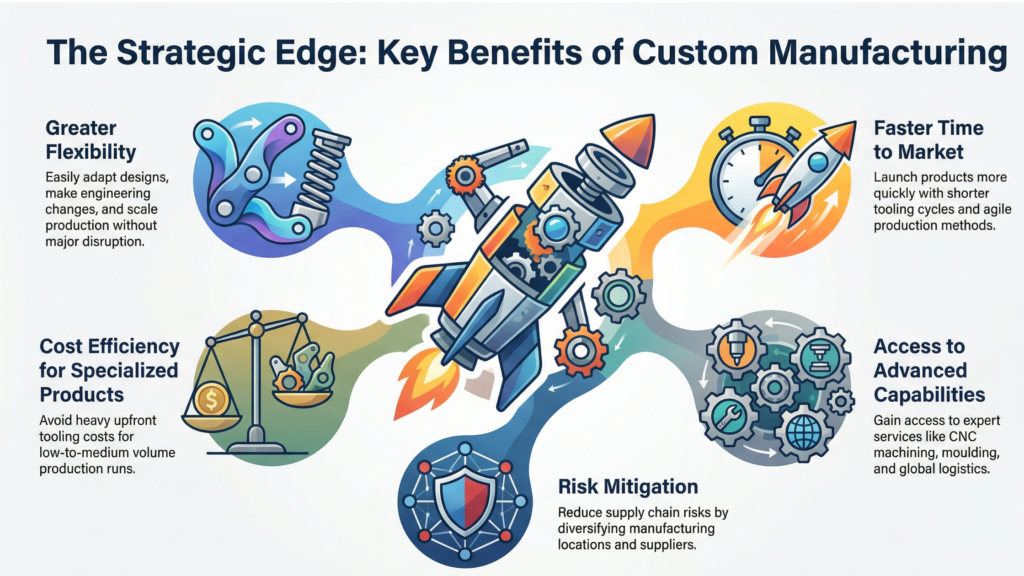
- Greater Flexibility
Custom manufacturing allows design changes, engineering modifications, and production scaling without major disruptions. - Faster Time to Market
With shorter tooling cycles and agile production, businesses can launch products faster. - Cost Efficiency for Specialised Products
For low-to-medium volumes, custom manufacturing avoids the high upfront costs of mass-production tooling. - Access to Advanced Capabilities
Partnering with experienced manufacturers provides access to CNC machining, moulding, assemblies, and global logistics. - Risk Mitigation
By diversifying manufacturing locations and suppliers, companies reduce offshoring and supply chain risks.
Disclaimer: This is an AI-generated image. AI images may have inaccuracies.
Materials Used in Custom Manufacturing
Custom manufacturing services support a wide range of materials, selected based on application needs.
- Metals: Steel, stainless steel, aluminium, brass, copper, alloys
- Plastics: ABS, nylon, polypropylene, polycarbonate
- Elastomers: Rubber and specialised polymers
- Composites: Fibre-reinforced materials for strength and weight reduction
Material flexibility is one of the strongest advantages of custom manufacturing.
Industries That Need Custom Manufacturing Service
Custom manufacturing plays a critical role in industries where standard, off-the-shelf parts simply don’t meet performance, safety, or design requirements. When precision, compliance, and flexibility matter, customised production becomes essential.
Automotive and EV Custom Manufacturing
The automotive industry, especially electric vehicles, relies heavily on custom manufacturing. From precision-machined components and forged parts to castings and sub-assemblies, every element must meet strict performance and safety standards. EV platforms often require new designs, lighter materials, and tighter tolerances, which makes custom manufacturing ideal for both prototyping and scalable production.
Industrial Machinery Custom Manufacturing
Industrial machinery rarely follows a one-size-fits-all approach. Equipment is often built for specific operating conditions, load capacities, or environments. Custom manufacturing enables the production of engineered components, robust sheet-metal enclosures, and mechanical assemblies that align perfectly with functional requirements and long service-life expectations.
Aerospace and Defence Custom Manufacturing
Aerospace and defence manufacturing demands extreme precision, reliability, and traceability. Components are usually produced in low volumes but must comply with rigorous quality and regulatory standards. Custom manufacturing supports complex geometries, specialised materials, and tight tolerances, making it a practical choice for mission-critical parts and assemblies.
Electronics and Electrical Custom Manufacturing
In electronics and electrical applications, space constraints, heat management, and protection are constant challenges. Custom housings, brackets, thermal components, and assemblies allow manufacturers to optimise designs for performance and durability. As products evolve rapidly, custom electronic manufacturing also offers the flexibility to update designs without major tooling changes.
Medical and Healthcare Custom Manufacturing
Medical and healthcare products require absolute accuracy, consistency, and compliance with regulatory standards. Custom manufacturing is used for specialised components, equipment parts, and assemblies where reliability is non-negotiable. Whether it’s supporting diagnostic equipment or medical devices, customised production ensures both performance and patient safety.
Challenges in Custom Manufacturing and How to Address Them
While custom manufacturing offers many advantages, it also presents challenges.
| Challenge | What It Means | Why It Becomes a Risk | How the Right Custom Manufacturer Helps |
| Design Complexity | Custom parts often involve unique geometries, tight tolerances, and evolving specifications | Misalignment between design and manufacturing can cause delays, rework, or performance issues | Strong engineering collaboration, design-for-manufacturability (DFM) reviews, and early-stage prototyping reduce errors and improve outcomes |
| Quality Consistency | Each batch must meet the same standards despite variations in materials or processes | Inconsistent quality can lead to rejections, downtime, or compliance failures | Robust quality systems, in-process inspections, and documented quality controls ensure repeatability across production runs |
| Supplier Coordination | Multiple processes, such as CNC machining, castings, sheet metal, plastic moulding, and assemblies, may be involved | Poor coordination can cause bottlenecks, missed timelines, and communication gaps | An integrated manufacturer manages suppliers, schedules, and workflows under a single point of accountability |
| Cost Control | Custom manufacturing often involves lower volumes and specialised tooling | Costs can escalate without clear planning, material optimisation, or process efficiency | Transparent costing, material selection guidance, and process optimisation help control spend without compromising quality |
How to Choose the Right Custom Manufacturer for Your Project
Selecting the right custom manufacturing service partner in India is critical for success. Here’s how:
- Evaluate Technical Capabilities: Ensure the manufacturer offers a comprehensive range of services, including CNC machining, castings, sheet metal, plastic moulding, and assemblies, all under one roof.
- Check Quality Standards: Look for robust quality control systems, inspections, and compliance processes.
- Supply Chain Strength: A strong procurement and logistics network ensures timely delivery and cost stability.
- Experience and Industry Exposure: Manufacturers with multi-industry experience bring better problem-solving and scalability.
- Global Delivery Capability: Worldwide shipping and local compliance support are essential for international businesses.
Why India Is a Preferred Destination for Custom Manufacturing
India combines engineering expertise, cost efficiency, and manufacturing scale. With a mature industrial ecosystem, skilled professionals, and advanced infrastructure, custom manufacturing solutions in India offer global businesses a strategic advantage.
Companies benefit from reduced lead times, diversified supply chains, and access to a wide range of manufacturing technologies.
Partner with the Right Custom Manufacturing Expert-Succinnova
Custom manufacturing in India and globally is now a strategic approach that offers flexibility and innovation, surpassing traditional mass production. Whether you need precision CNC parts or comprehensive manufacturing support, partnering with the right company is crucial. Succinnova serves as your trusted partner for manufacturing and supply chain solutions in India, with expertise in CNC machining, castings, forgings, and other related services. We help global businesses enhance their competitiveness, minimize risk, and accelerate lead times.
If you’re seeking reliable custom manufacturing services, explore how we can elevate your production strategy. Contact Succinnova today for smarter and more resilient manufacturing solutions.
Frequently Asked Questions (FAQs)
Is custom manufacturing suitable for small production runs?
Yes, it is ideal for prototypes, low-volume production, and specialised components.
Can custom manufacturing scale to higher volumes?
Yes, with proper planning and tooling, custom manufacturing can scale efficiently.
What is a custom manufacturer?
A custom manufacturer produces parts, components, or assemblies based on specific customer designs and requirements rather than standard, off-the-shelf products.
What is a custom manufacturing system?
A custom manufacturing system is a flexible production setup designed to handle unique designs, varying volumes, and specialised processes while maintaining quality and efficiency.
What is an example of custom manufacturing production?
An example of custom production is the manufacturing of CNC-machined components and assembled kits for an industrial machine designed for a specific application or operating environment.
More Blog
13 Main Types of CNC Machines and Their Applications
Computer Numerical Control (CNC) machines have transformed modern manufacturing...
What is Custom Manufacturing Service?
In today’s competitive global market,...